
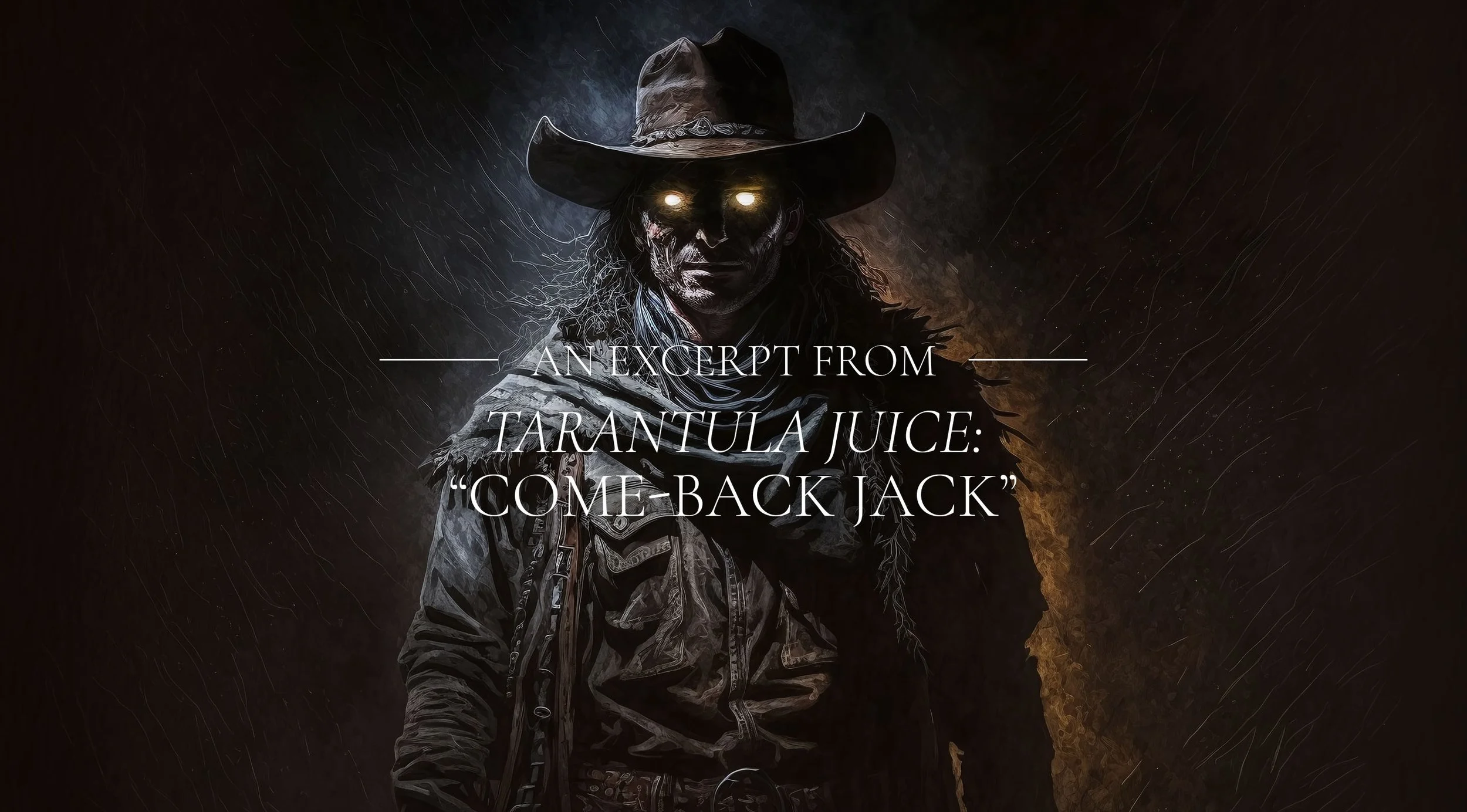
Folks always said ol’ come-back Jack was gonna drink himself into a casket. What they never expected was for him to drink himself out of one. But that piece of the story comes later, and requires a bit of preamble. You see, in order to know the story of come-back Jack, you also need to know about his brother, doesn’t-die Jules. The two men were tangled together as much in life as in their strange, questionable deaths, and it all began in the womb of a young prostitute by the name of Katarina Darke.
Miss Darke, as her name implies, was a woman of dark beauty. Her olive skin and ebony hair caught the eyes of many a man, including a dangerous outlaw known as Charles Slade. Slade frequented an establishment called Madam Belle’s — a brothel in the red light district of Carlyle, Illinois. It was there that he met Katarina, whose strong will, fiery pride, and brooding disposition ensnared his heart as much as her form bewitched his senses. Slade favored the girl above all others, and when it was discovered that she was with child, he declared the offspring to be his and demanded the baby and its mother be turned over to him as soon as it was born. Katarina, who had no intention of going with Charles Slade, refused. The outlaw became angry, violent. He harassed the poor girl to the point that Madam Belle banned him from her establishment, which only provoked Slade even more.
When the time came for the child to be born, Slade and a group of his men ambushed Madam Belle’s, leaving naught but bullets and bloodshed in their wake. Charles found the girl in a hidden back room only to discover she had perished in the throes of childbirth. Her children, though — twin boys — had survived. Slade would’ve taken the infants that very night if not for the bravery of Katarina’s midwife. Slade had paid the young woman no mind, and when his back was turned, she buried a dagger between his shoulders and stole the children away to raise as her own. And so the Slade twins came into the world baptized in violence and blood. This ill omen would not, however, come to fruition for many years, long after the boys had grown into men and ventured out into the world on their own.
The Slade twins started out well enough. Jack, the younger of the two by thirteen minutes, was a businessman. Though twins, the brothers were not identical; Jack had inherited his mother’s swarthy appearance and bewitching charm, which only served to aid his reputation and advance his endeavors. He started his own stage line out of Virginia City, Montana with Jules, the elder. For a few years, the brothers scratched out their living on the dusty, packed dirt roads between towns, forts, and outposts, transporting passengers, goods, mail, money, and anything that needed moving for a modest fee. It was dangerous work, as robbers were apt to fall upon stagecoaches and their drivers unawares. The Slade brothers, however, protected their cargo with a strict “shoot first, ask questions later” policy. As time went on, Jack and Jules joined their route and coaches with the Overland Stage Line, securing their livelihood and their reputations as terrors to thieves and outlaws. Jack, who quickly rose to the position of station master, was known to shoot and hang bandits on sight, and his brother, a grizzled, bearlike man of a particularly nasty temper who had taken after their father in more ways than just his appearance, was rumored to do worse.
As the years progressed, it appeared that Jack and Jules were on their way to becoming the most well-known (and the most feared) whips in the West. The Slade brothers might even have acquired management of Overland Stage Line for themselves if not for Marie Dale.
Marie, a quiet, gentle spirit of considerable beauty, stole Jack’s heart with her fair hair, milky skin, and jade-colored eyes. The two fell hopelessly in love and were married within a fortnight of meeting one another. They settled in a lone cabin in the nearby mountains, and although Jack was passionately fond of his wife, even she could not keep him from the open road. The rugged, untamed country of the American West called to Jack’s wild, untethered heart, and he could not help but heed it. Over time, separation starved their passion, and Marie, heartbroken and forlorn, sought comfort in the arms of the only other man in her life: her husband’s brother.
One night, after an especially tempestuous storm buried Jack’s route beneath snow and mud and loose rocks, he returned home to find Jules and Marie in bed together. Enraged, Jack drew down on his brother but only managed to take off one of his ears. Jules escaped out the window, and Jack vowed revenge if he ever laid eyes on him again. As for Marie, her sorrows would only increase. Jack almost never returned home after that, choosing instead to camp along his routes and avoid his desperate, miserable wife. The opportunity for revenge would come, and with it the consummation of that bloody portent — one might even call it a curse — that had hung over the brothers like a pall since the day of their birth…
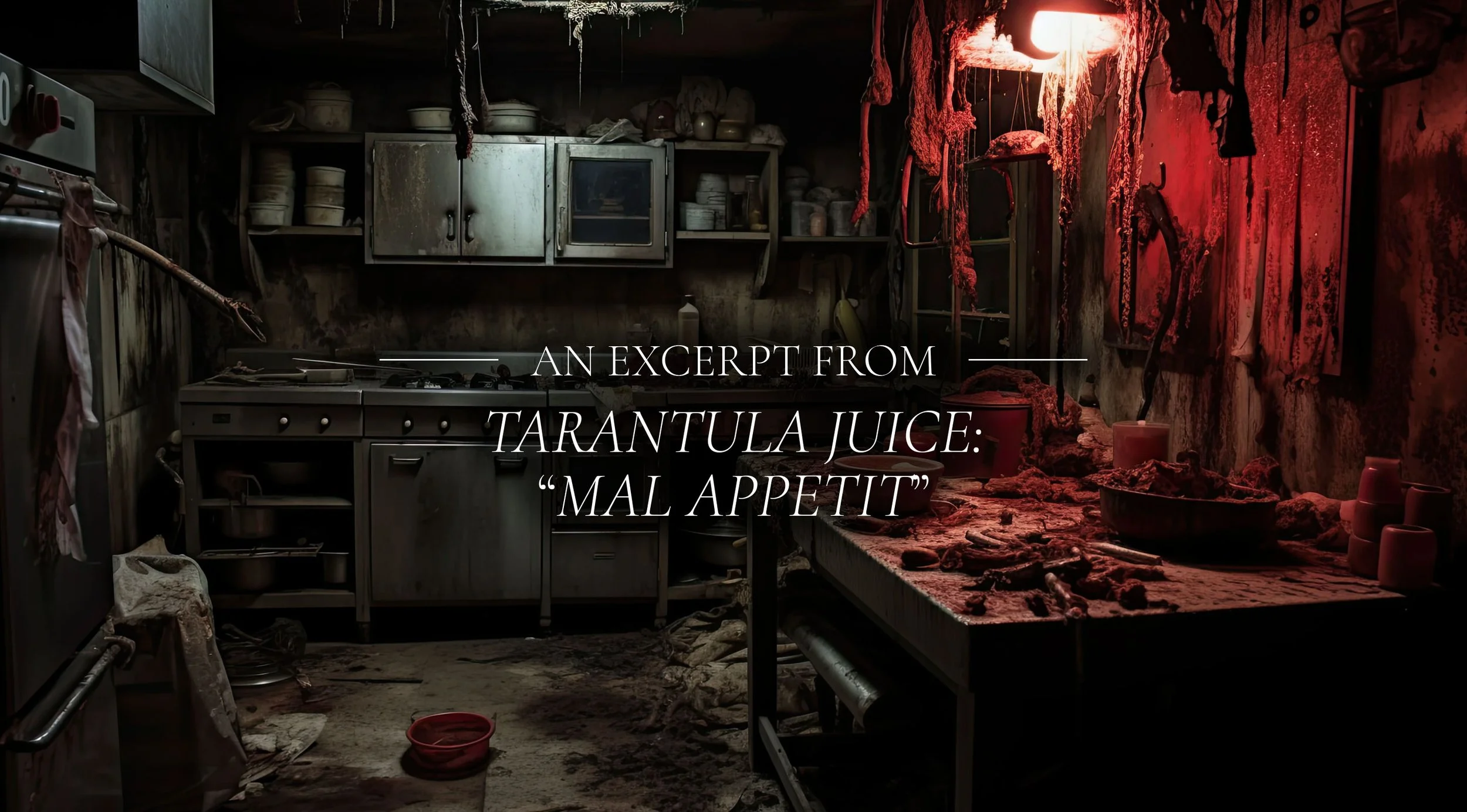
It would hardly be an exaggeration to say that the foundation of Basil and Virginia Cobb’s marriage was, solely and uncontestedly, their mutual love of food. It began when Basil met Virginia (back then, she was known as Virginia Colby) at his favorite French café: Le Central. He’d noticed her several times out of the corner of his eye (always on Tuesdays and Thursdays, he noted) sitting in the same low-lit corner enjoying one of the same three dishes: moules-frites, cuisses de grenouille paired with escargot, or — her favorite, judging by how often she ordered it — foie gras. She hadn’t been as heavy back then. Plump, yes. Curvy, sure. But she had yet to reach those Brobdingnagian proportions that Basil positively slavered over. But he saw Virginia’s potential in the way she greedily slurped down the mussels and chomped away at the fries, the way she smacked and slopped her way through the frogs’ legs and snails, and the way she slowly, deliberately nibbled and savored every morsel of rich, buttery, melt-in-your-mouth duck liver as if it were her last meal.
He’d observed her a month or so before approaching her to make sure she was a true bon vivant and not some unfulfilled housewife or disconsolate divorcée attempting to eat her way through a bout of depression. Basil paid the tab for his meal — steak tartare with toast points and cornichons paired with a slightly chilled, light-bodied Beaujolais — rose, and made his way over to Virginia’s table. She was so engrossed in her frog legs and snails that she didn’t even see him until he was standing right next to her, and still probably wouldn’t have noticed his presence if he hadn’t cleared his throat.
“Ahem…”
Virginia’s round, pink face popped up, one hapless amphibian’s leg jutting from her pursed lips, her eyes as round as the plate she was eating off of. Without so much as missing a beat, she pushed the rest of the leg into her mouth with one red-nailed finger, chewing loudly, and said in a slow, Appalachian drawl, “Do I know you?” There was a greasy spot of butter on her fleshy chin that glistened in the low candlelight, and Basil resisted the urge to wipe it away and lick the salty liquid off his fingers.
“Name’s Basil Cobb, ma’am,” he said with a nod and a smile. “What’s yours?”
“Virginia. Virginia Colby,” she answered. “Now what do you want?”
“Well,” Basil said, donning a smarmy grin. “I was wonderin’ if I could interest you in some dessert. Crème Brûlée, perhaps? An order of profiteroles? An éclair to share?”
Virginia’s eyes narrowed. “I will not abide your jests, Mr. Cobb. I am well aware that I am, as they say, a ‘big woman.’ So you can just turn around and march your little beanpole heinie back the way you came.”
Basil raised both hands in a gesture of defense. “You misunderstand me, Miss Colby. I meant no offense. I simply wanted to get to know you. But I can see that I’ve upset you. I’ll take my leave.”
He turned to go, but hadn’t gone more than two steps when Virginia said, “Now hang on a minute.”
Basil grinned to himself and turned to look at her.
“No foolin’ now. Did you mean what you said, Mr. Cobb?”
“I did indeed, ma’am.”
“Well … then I suppose I’d like an éclair.”
Basil took the seat across from her, his tall, lean form the Jack Sprat to her Joan. “To share?” he said, one sly eyebrow sneaking up his forehead.
Virginia turned a violent shade of red and giggled like an infatuated school girl. Her cheeks jiggled when she laughed, and that tempting smear of butter was still shining on her chin. “Shall we meet in the middle?” she asked coyly.
Basil chuckled and replied, “But of course, my dear,” as he flagged down the garçon…
Flip the sign, Wendell, dear. My arthritis is acting up again…”
“Yes, Grammaw.”
“And for heaven’s sake, don’t forget to unlock the door this time.”
“I won’t, Grammaw.”
The thin plastic sign and its chain rattled against the etched, oval-shaped glass in the heavy oak door of Lilli’s Secondhand Emporium. Blocky, fire-engine-red letters that screamed CLOSED were traded for the inviting brush strokes of the word Open — white calligraphy on a field of sky blue. It was summer, and tourists were thick in the streets of the little town of Rawlins, Wyoming. They came for the hiking, fishing, golfing, and boating primarily, but downtown Rawlins was a historic district, and the shops saw their fair share of commerce, too. The little brass bell above the door began its customary jangling not five minutes later as the first of the tourists streamed in, eager to see what souvenirs they might find hiding on the dusty shelves or tucked away in one of the shop’s many nooks.
Grammaw greeted each one of them with a smile and a “Take a look around, there’s somethin’ for everybody!” Wendell did not deal with customers. He’d never been good with people, as his grammaw was always quick to point out. “Why don’t you find yourself a nice girl, Wendell?” she asked every evening as they sat down to dinner together in front of the television. “Surely you’d like to find a nice girl?”
Wendell would silently shrug, hunched over his plate with his eyes fixed on the TV’s glowing screen.
“You don’t want to live in my basement forever, do you?” she’d ask.
Again, Wendell would shrug and go on eating his food.
“Well, I suppose you’ve never been very good with people, have you, dear?”
“No, Grammaw,” he would reply. And that would be the end of the conversation.
Wendell would finish his dinner and retreat to the basement, which had been partially finished and converted into a pseudo-living space. Orange carpet covered the cement floors, and the walls (which were cement as well) had been painted an off-white. A pair of mattresses with a tattered plaid quilt and a few mismatched pillows took up residence in the corner, and a set of bookshelves leaned against the opposite wall. A single light bulb hung from the exposed beams overhead, flinging sharp shadows into the corners and up into the rafters. Other than a dresser, a threadbare armchair and side table, and a leaky old washing machine and dryer tucked away in a small alcove, Wendell had left the space open.
It was here that he spent the evenings going through his collection of odds and ends he’d salvaged from his grammaw’s secondhand store. Most of it consisted of stuff the old woman had thrown out, items that she said either “would never sell in a hundred years” or “had an air about ‘em.” The “air,” Wendell learned, was never good. Grammaw was very superstitious. She claimed she could sense things about an object when she handled it, things from its past and the people who’d owned it. Sometimes all it took was a look.
Once, despite the NO DUMPING and SMILE! YOU’RE ON CAMERA signs, someone had left a box of junk on the back step for them to find. Wendell brought it inside and started going through its contents when his grammaw looked up suddenly from her bookwork, turned her eyes upon an innocent looking porcelain doll, and said, “Not that, Wendell. Put it in the garbage.” Wendell knew better than to object, but later that night after they returned home, he’d asked her about the doll. She’d replied with a small shudder, “There was somethin’ attached to it. Somethin’ cold … somethin’ evil. I felt it the second you pulled it outta that box.”
Wendell had no use for a porcelain doll, so he’d obliged his grammaw’s wishes. But most of the time he smuggled away the things she didn’t want for himself. The old lady never came downstairs anymore — the arthritis in her hips made the task too painful — so Wendell’s collection was his own little secret. Over the years, he’d accumulated an impressive assortment of toiletry and tobacco tins; odd lamps (his favorite was an old plastic Donald Duck whose face had started to brown and warp from the heat of the bulb inside); strange sculptures and unnerving paintings created by would-be artists who clearly lacked the talent; brittle, faded magazines; gaudy bric-a-brac, lurid knickknacks, and worthless baubles; and a vast array of taxidermied animals in weird and outlandish poses. But the most prized part of Wendell’s collection consisted of over two hundred pairs of shoes…